...I have a lot going on, a lot on my mind, and alot I could actually post about right now. Trouble is, I can't seem to find the words...or at least the right words that would prevent me from coming off like a royally cranky bitch.
I'm not sure what's going on here lately, but my mood has been dark, my fuse short, and my overall attitude could use some serious improvement.
Part of it is the car situation (we are still waiting for the minivan which is a long story I am not going to get in to).
Part of it is that the weather SUCKS (except for a day or two here and there that actually feels like spring, it's been cold or rainy or even threatening to snow for the better part of the month). All I am asking for is 60's and sunny. Seriously, it's April frickin' 11th...can we say BYE BYE Winter?
Part of it is being worried about the results of Julia's genetic testing (even though I am trying to put it out of my mind, and even though I feel confident that the results will come back normal). It's always in the back of my mind and the waiting game STINKS.
Part of it is just being me...which means being busy and not busy enough at the same time (don't ask, it's a hard concept to explain). It means feeling extremely lazy at times and feeling guilty about it. It means being a procrastinator. It means being a wife and Mom, which in and of itself can be overwhelming.
Part of it is being concerned about Katherine, who gained 17 lbs in one years time (which is a lot for a kid) and is still not potty trained at night at the age of 7 1/2. These two things, compiled with her diagnosis of ketotic hypoglycemia, which her endocrinologist said can be a precursor to diabetes, have me worried. More than that, her pediatrician, whom I usually adore seems to think that putting an alarm in her pants (yeah I know) will solve the problem. Basically the alarm gets wet and it sounds and is supposed to wake the kid up and get them to go in the toilet. That's all fine and freakin' dandy, but lets talk about why she pees like 50 times a night, huh? Procrastination comes in to play quite nicely here too, because I am deathly afraid that I am going to make an appointment at her endocrinologist and he is going to do the glucose tolerance and blood sugar tests and tell me she's diabetic. And I just can't take anymore of this medical crap. Yes, yes, yes I know I need to and I will. It's just, you know, one more thing.
I know my family has noticed the gloom lately too, and for reasons I can't get in to here, I know that based on past experiences, they are probably worried. That in and of itself, even with the best of intentions in mind can be aggravating because, well, I am human, ya know? Just because I am going through a "thing" right now, doesn't mean I am going to go off the deep end. The difference between the past in the present is my mindset. Yes, life is tough right now, but it's not the end of the world. Something will come along that will bring me back to my senses and I will be fine again. Something always comes along...it's the natural way of things I think.
Wednesday, April 11, 2007

Tuesday, April 10, 2007
Umm...
A little while ago, I heard Julia walk through the kitchen and into our bedroom. Shortly after that, I heard jumping on the bed. The last time she did this she jumped and ended up whacking her head on the window so jum ping on the bed has since been outlawed.
I was sitting in the office (which is right next to the bedroom) and all I said was (in a somewhat stern voice), "Julia."
She said, "I know Mom, I 'posed to be on my bum. Don't yell at me."
This was definitely one of those, "Did she really just say that?" moments. Needless to say, her language delay is becoming less and less of a concern with each passing day.
Sheesh.
I was sitting in the office (which is right next to the bedroom) and all I said was (in a somewhat stern voice), "Julia."
She said, "I know Mom, I 'posed to be on my bum. Don't yell at me."
This was definitely one of those, "Did she really just say that?" moments. Needless to say, her language delay is becoming less and less of a concern with each passing day.
Sheesh.
Re-Posting An Old Entry...
...for reasons which should be fairly obvious.
Annoying...when someone calls my house and doesn't leave a message. I have an answering machine for a reason. You called me so you must have something to say. So you know, say it. If I have a message, I will return it, but if you call and don't leave one, I am not going to bother calling you back. REPEAT: NO MESSAGE FROM YOU MEANS NO CALL BACK FROM ME.
Even more annoying...when someone calls once, doesn't get an answer, doesn't leave a message and then continues to call repeatedly...and still doesn't leave a message. Obviously I am either not here, busy, or plain and simple don't feel like talking on the phone. Again, I have a machine for a reason.
And just in case we're not clear on what the reason is...its purpose is to take messages, so that I can hear them and respond accordingly.
Annoying...when someone calls my house and doesn't leave a message. I have an answering machine for a reason. You called me so you must have something to say. So you know, say it. If I have a message, I will return it, but if you call and don't leave one, I am not going to bother calling you back. REPEAT: NO MESSAGE FROM YOU MEANS NO CALL BACK FROM ME.
Even more annoying...when someone calls once, doesn't get an answer, doesn't leave a message and then continues to call repeatedly...and still doesn't leave a message. Obviously I am either not here, busy, or plain and simple don't feel like talking on the phone. Again, I have a machine for a reason.
And just in case we're not clear on what the reason is...its purpose is to take messages, so that I can hear them and respond accordingly.
Say what you will...
...about Barney but there couldn't possibly be anything cuter than your two year old daughter, purposely seeking you out when the end song comes on, just so she can give you a kiss and hug during the part of the song that says, "with a great big hug and a kiss from me to you." I am sorry, but listening to that annoying dinosaur might be worth it just for that.
Seriously.
Seriously.
Monday, April 9, 2007
Sunday, April 8, 2007
Happy Easter!
We spent the day at my sisters, where we enjoyed a lovely ham dinner, desserts that were too good(if there is such a thing) and some quality time with the extended family. Here are some pictures!
Emily proves that not only can she act the part of teenager, she can look it too! This is starting to become a serious problem...her looking all grwon up! Just who does she think she is?

Julia was not in the picture mood this morning. I wanted to get a good shot of her in her cute Easter dress...this was the best I could do! Eyes closed even, she's the cutest 2 year old in the world!

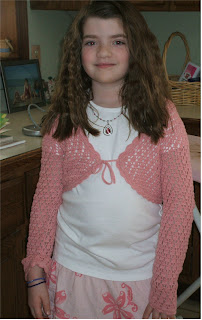
Katherine, all dressed in her Easter attire and ready to head out the door.

Jack and Julia are so cute. They play so well together (minus the part where Jack bonked Julia over the head with a wooden drumstick...ha ha ha).
Jack goes in for a hug.
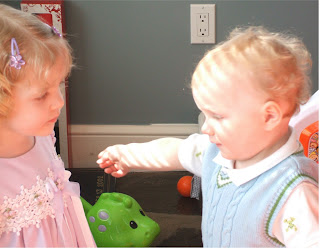
While leaning in for a kiss, Jack looks at me and seems to say, "Hey Aunty, are you getting this shot?"

Proof positive that they are feeling the love..a one and half and two and a half year old sharing toys? Well now, that's unheard of!

Emily proves that not only can she act the part of teenager, she can look it too! This is starting to become a serious problem...her looking all grwon up! Just who does she think she is?


Julia was not in the picture mood this morning. I wanted to get a good shot of her in her cute Easter dress...this was the best I could do! Eyes closed even, she's the cutest 2 year old in the world!

Katherine, all dressed in her Easter attire and ready to head out the door.

Jack and Julia are so cute. They play so well together (minus the part where Jack bonked Julia over the head with a wooden drumstick...ha ha ha).
Jack goes in for a hug.

While leaning in for a kiss, Jack looks at me and seems to say, "Hey Aunty, are you getting this shot?"

Proof positive that they are feeling the love..a one and half and two and a half year old sharing toys? Well now, that's unheard of!

NCLB: Defined
I recently attended a conference workshop called, "NCLB:What's In It For Families." I leanred a lot from it, and thought it may be useful to those who still have questions about what it is all about, to post a summary of the information I came back with.
The No Child Left Behind Act is part of the Elementary and Secondary Education Act that was originally passed by Congress in 1968. It provided for the first time, significant federal funding for k-12 education. The original law has been renewed many times, most recently by NCLB.
The first part of ESEA is "Improving the Academic Achievement of the Disadvantaged", more commmonly called Title I. Schools that educate the disadvantaged children of this nation receive Title I money, which is the largest portion of the federal k-12 education funds. More than half of all public schools are "Title I schools."
All Title I schools must meet certain requirements set forth by NCLB in order to get federal funding. In addition, additional measures are required in order to ensure that America's neediest students are no longer left behind. NCLB works according to four common-sense principles; accountability, flexibility in how the federal money is spent, scientific research to guide classroom practice, and involving parents by giving them information and choices about their child's education.
For the first time, public schools are being held accountable for results, including results for those groups of children who typically don't perform well. The measure of accountability is Adequate Yearly Progress (AYP). AYP is defined by the states. Certain goals are set for student achievement and progress is measured by how well students perform on state developed tests. In Massachusetts, one such test is called the Massachusetts Comprehensive Assessment System (MCAS). To make AYP, schools must meet, or make significant progress towards the levels of achievement defined on these tests. NCLB requires schools test your child in reading and language arts and math every year in grades 3-8 by using a state developed test.
Local report cards are prepared for every school that receives Title I funds. These reports must be easy to understand and available to all parents. This report card will show the results of the state testing for the school as a whole. Individual reports are mailed to the students home. For schools that are in need of improvement (which means they have not made AYP for two consecutive years or longer) options such as school choice and supplemental educational students must be offered. School choice offers parents that option of transferring their student to another public school. The school district must provide transportation for your child. Supplemental Education Services could be free tutoring, homework help, or other extra help outside of the regular school day. Your child may qualify if he or she is eligible for free or reduced priced lunch and they attend a Title I school that has not made AYP for three years or longer.
NCLB gives the states and schools more control and flexibility to use the federal money and resources where they are needed most. Principals and administrators can move funds from one program to another as they see fit.
NCLB provides more federal funding for states than ever before. While the majority of the funding for k-12 education comes from the states and communities, the federal share has been rising, and was at 8.3 percent in 2005, up from 5.7 percent in 1991. Another major component of the federal k-12 education program is the Individuals With Disabilities Education Act, which has also seen its funding increased in recent years.
NCLB provides funding to help teachers through training and other professional development opportunities. The law also requires that teachers of core academic subjects be highly qualified. Highly qualified is defined as a teacher with one bachelor's degree, full state certification, and demonstrated competence for each subject taught. If your child is in a Title I school, NCLB requires that you know that you have the right to obtain and how to obtain information about the qualifications of your child's teachers.
NCLB requires that districts develop ways for parents to become more involved. This empowers you, as a parent to ask questions and make informed decisions regarding your child's education. Schools must have written policies on parent involvement and provide that information to you.
More than $1 billion a year under NCLB goes to help children learn to read through the Reading First program. This program is dedicated to helping ensure that all children learn to read on grade level by the third grade. The money provides schools the power to support high quality reading programs based on scientific research.
Clearly, I learned a lot about NCLB at this workshop. One of the key things I took back from it was that it's not, in my opinion, as bad as a thought it was. It makes sense for both teachers and children to be held accountable for what they are doing. It makes sense for teacher's to be highly qualified in the subjects they are teaching. Progress should be measured to see if what you are doing is working. I don't think the only measure of this progress should be a state test, in the case of Massachusetts the MCAS. I've said this before and I'll say it again: Some people just don't test well. A brilliant student, who otherwise gets high marks could fail the MCAS and not be able to graduate high school. This is just not right.
I still think my major gripe with NCLB is funding. I just don't think it's right to hold the schools responsible for high standards on a federal level, and then expect the schools, communities and states to come up with most of the funding to support and achieve it. If the public school system is going to be regulated by the federal government, the federal government should pay for it. I suppose there will never be a happy medium when it comes to this type of thing but something somewhere is just not working.
Coming soon...and entry about the proposed cuts to educational funding in my town and how I feel about that.
The No Child Left Behind Act is part of the Elementary and Secondary Education Act that was originally passed by Congress in 1968. It provided for the first time, significant federal funding for k-12 education. The original law has been renewed many times, most recently by NCLB.
The first part of ESEA is "Improving the Academic Achievement of the Disadvantaged", more commmonly called Title I. Schools that educate the disadvantaged children of this nation receive Title I money, which is the largest portion of the federal k-12 education funds. More than half of all public schools are "Title I schools."
All Title I schools must meet certain requirements set forth by NCLB in order to get federal funding. In addition, additional measures are required in order to ensure that America's neediest students are no longer left behind. NCLB works according to four common-sense principles; accountability, flexibility in how the federal money is spent, scientific research to guide classroom practice, and involving parents by giving them information and choices about their child's education.
For the first time, public schools are being held accountable for results, including results for those groups of children who typically don't perform well. The measure of accountability is Adequate Yearly Progress (AYP). AYP is defined by the states. Certain goals are set for student achievement and progress is measured by how well students perform on state developed tests. In Massachusetts, one such test is called the Massachusetts Comprehensive Assessment System (MCAS). To make AYP, schools must meet, or make significant progress towards the levels of achievement defined on these tests. NCLB requires schools test your child in reading and language arts and math every year in grades 3-8 by using a state developed test.
Local report cards are prepared for every school that receives Title I funds. These reports must be easy to understand and available to all parents. This report card will show the results of the state testing for the school as a whole. Individual reports are mailed to the students home. For schools that are in need of improvement (which means they have not made AYP for two consecutive years or longer) options such as school choice and supplemental educational students must be offered. School choice offers parents that option of transferring their student to another public school. The school district must provide transportation for your child. Supplemental Education Services could be free tutoring, homework help, or other extra help outside of the regular school day. Your child may qualify if he or she is eligible for free or reduced priced lunch and they attend a Title I school that has not made AYP for three years or longer.
NCLB gives the states and schools more control and flexibility to use the federal money and resources where they are needed most. Principals and administrators can move funds from one program to another as they see fit.
NCLB provides more federal funding for states than ever before. While the majority of the funding for k-12 education comes from the states and communities, the federal share has been rising, and was at 8.3 percent in 2005, up from 5.7 percent in 1991. Another major component of the federal k-12 education program is the Individuals With Disabilities Education Act, which has also seen its funding increased in recent years.
NCLB provides funding to help teachers through training and other professional development opportunities. The law also requires that teachers of core academic subjects be highly qualified. Highly qualified is defined as a teacher with one bachelor's degree, full state certification, and demonstrated competence for each subject taught. If your child is in a Title I school, NCLB requires that you know that you have the right to obtain and how to obtain information about the qualifications of your child's teachers.
NCLB requires that districts develop ways for parents to become more involved. This empowers you, as a parent to ask questions and make informed decisions regarding your child's education. Schools must have written policies on parent involvement and provide that information to you.
More than $1 billion a year under NCLB goes to help children learn to read through the Reading First program. This program is dedicated to helping ensure that all children learn to read on grade level by the third grade. The money provides schools the power to support high quality reading programs based on scientific research.
Clearly, I learned a lot about NCLB at this workshop. One of the key things I took back from it was that it's not, in my opinion, as bad as a thought it was. It makes sense for both teachers and children to be held accountable for what they are doing. It makes sense for teacher's to be highly qualified in the subjects they are teaching. Progress should be measured to see if what you are doing is working. I don't think the only measure of this progress should be a state test, in the case of Massachusetts the MCAS. I've said this before and I'll say it again: Some people just don't test well. A brilliant student, who otherwise gets high marks could fail the MCAS and not be able to graduate high school. This is just not right.
I still think my major gripe with NCLB is funding. I just don't think it's right to hold the schools responsible for high standards on a federal level, and then expect the schools, communities and states to come up with most of the funding to support and achieve it. If the public school system is going to be regulated by the federal government, the federal government should pay for it. I suppose there will never be a happy medium when it comes to this type of thing but something somewhere is just not working.
Coming soon...and entry about the proposed cuts to educational funding in my town and how I feel about that.
Subscribe to:
Posts (Atom)